That Satisfying Park Click Is Your Transmission's Weakest Link — Not Its Strongest
The Sound of False Security
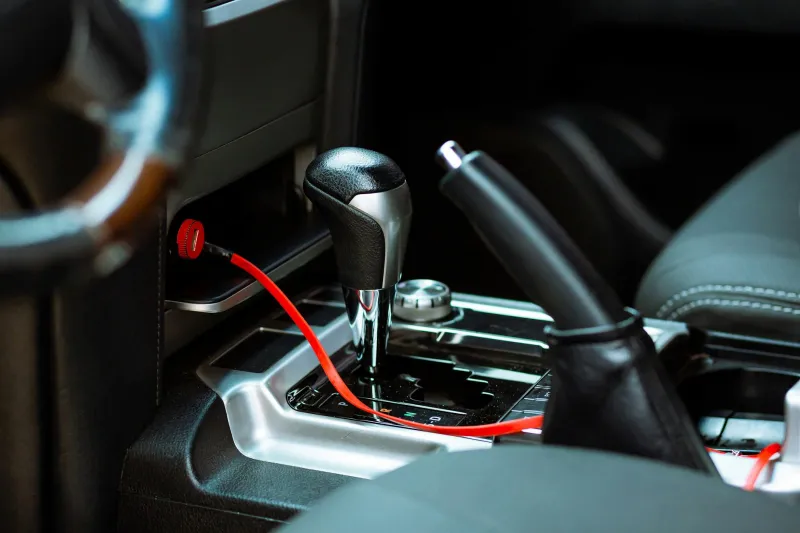
There's something deeply satisfying about shifting into Park. That solid mechanical click suggests your car is locked down tight, held in place by robust automotive engineering. It feels final, secure, unshakeable.
That feeling is mostly an illusion.
What you're actually hearing is a small metal piece called a parking pawl dropping into place—and it's doing a job it was never really designed to handle alone.
Inside the Park Position
When you shift an automatic transmission into Park, you're engaging one of the simplest mechanisms in your entire car. A spring-loaded pawl (essentially a metal hook) drops into the teeth of a gear called the park wheel. This prevents the transmission output shaft from rotating, which keeps your wheels from turning.
Sounds robust, right? Here's the catch: that pawl is roughly the size of your thumb, and it's trying to hold back several thousand pounds of vehicle weight.
The system works fine on level ground, where the pawl only needs to prevent rolling. But on any meaningful slope, physics starts working against that little piece of metal. The steeper the grade, the more stress gets concentrated on the pawl and the single tooth it's engaged with.
What Happens When Things Go Wrong
Parking pawls do break, and when they fail, the results are dramatic. The car suddenly starts rolling, often accompanied by grinding noises from the transmission as broken metal pieces bounce around inside.
More commonly, the pawl gets stuck. This happens when you park on a hill without using the parking brake first. The car's weight settles onto the pawl, creating so much pressure that the mechanism can't disengage when you try to shift out of Park. You'll hear the starter cranking, but the shifter won't budge.
Even when nothing breaks, relying solely on the parking pawl creates unnecessary stress throughout the transmission. The entire weight of your vehicle gets transferred through the transmission case, motor mounts, and drivetrain components—none of which were designed to serve as parking anchors.
The Parking Brake Decline
Generations of drivers grew up using parking brakes religiously, but the habit has largely disappeared. Part of this stems from the transition from manual to automatic transmissions. Manual cars require the parking brake because there's no Park position—just neutral.
As automatics became dominant, the parking brake seemed redundant. Why pull a lever when you can just shift into Park? This thinking got reinforced by parking brake problems in older cars, where cables would freeze or stretch, leaving drivers stuck.
Modern parking brakes are far more reliable, but many drivers never learned to use them properly. The result is an entire generation that treats the parking brake as emergency equipment rather than standard operating procedure.
How Parking Brakes Actually Work
Unlike your regular brakes, which use hydraulic pressure to squeeze pads against rotors, parking brakes use mechanical force—usually cables or electric motors—to directly engage the brake mechanism. This creates a completely separate system that doesn't depend on brake fluid, hydraulic pressure, or engine power.
Most importantly, parking brakes grab the wheels themselves, not the transmission. This distributes the holding force across components designed to handle it: brake pads, rotors, and wheel assemblies built to withstand thousands of pounds of stopping force.
The mechanical advantage is significant. A properly adjusted parking brake can hold a vehicle on grades that would overwhelm a parking pawl.
The Right Sequence Matters
Here's the procedure that protects your transmission and ensures reliable parking: come to a complete stop, engage the parking brake while your foot is still on the regular brake pedal, then shift into Park.
This sequence lets the parking brake bear the vehicle's weight instead of the transmission. When you shift into Park, the pawl drops into place as a backup, not as the primary holding mechanism.
When leaving, reverse the process: start the engine, shift out of Park (the pawl disengages easily because it's not under stress), then release the parking brake as you begin to drive.
Electric Parking Brakes Change Everything
Many newer vehicles feature electronic parking brakes that engage automatically when you shift into Park. These systems recognize what many drivers have forgotten: the parking brake and transmission Park position work better together than either does alone.
Electronic systems also eliminate the most common excuse for not using the parking brake—forgetting to engage it. The car handles the decision automatically, ensuring the parking brake engages every time.
Some systems even include hill-start assist, which temporarily maintains brake pressure when you're starting from a stop on an incline. This prevents the momentary rollback that can occur with manual parking brakes.
Why This Matters Beyond Transmission Protection
Using proper parking procedures isn't just about avoiding costly transmission repairs. It's about predictable vehicle behavior and safety margin.
Parking pawls can fail without warning, especially as vehicles age. A parking brake provides redundancy—if one system fails, the other keeps your car stationary. This matters most in situations where rolling could cause injury or property damage.
The habit also transfers to other vehicles. Rental cars, borrowed vehicles, and older cars all benefit from proper parking brake use, regardless of their specific transmission design.
Breaking the Park-Only Habit
If you've spent years relying solely on the Park position, switching to proper parking brake use takes conscious effort. Start by practicing the correct sequence in your own driveway, where mistakes don't matter.
Pay attention to how the car feels when you use both systems together. You might notice less vibration when shifting out of Park, or smoother engagement when the pawl isn't fighting against vehicle weight.
The satisfying click of the Park position isn't going anywhere—it's just becoming part of a more complete parking system instead of a single point of failure.
That little pawl inside your transmission is doing its best, but it was never meant to be a hero. Give it some help.